
A ready-to-eat meal that keeps for 18 months without refrigeration naturally raises a question: how is this possible without preservatives? A long shelf life can be achieved through the production process itself, rather than additional additives. So what happens at the factory to make ready-to-eat food suitable for storage at room temperature, and how does the manufacturer ensure it remains safe throughout its stated shelf life?
According to Marijus Bakas, Head of the Ready-to-Eat Meals Business at Kauno grūdai, the easiest way to understand the process is to think back to how food was traditionally preserved at home for winter.
“Imagine how our grandmothers prepared food for winter: they would chop vegetables, make a vegetable dish or stew using their own recipe, place it in thoroughly washed jars, seal them tightly and heat them. This allowed the food to be stored for a long time without adding preservatives,” explains Bakas.
A similar principle is used to make Activus products, except that the entire process takes place in specialised equipment under precisely controlled conditions.
“We select the right temperature and heating time for each dish to ensure the product is safe while retaining its flavour, colour and texture. This allows us to achieve a longer shelf life without adding preservatives,” he says.
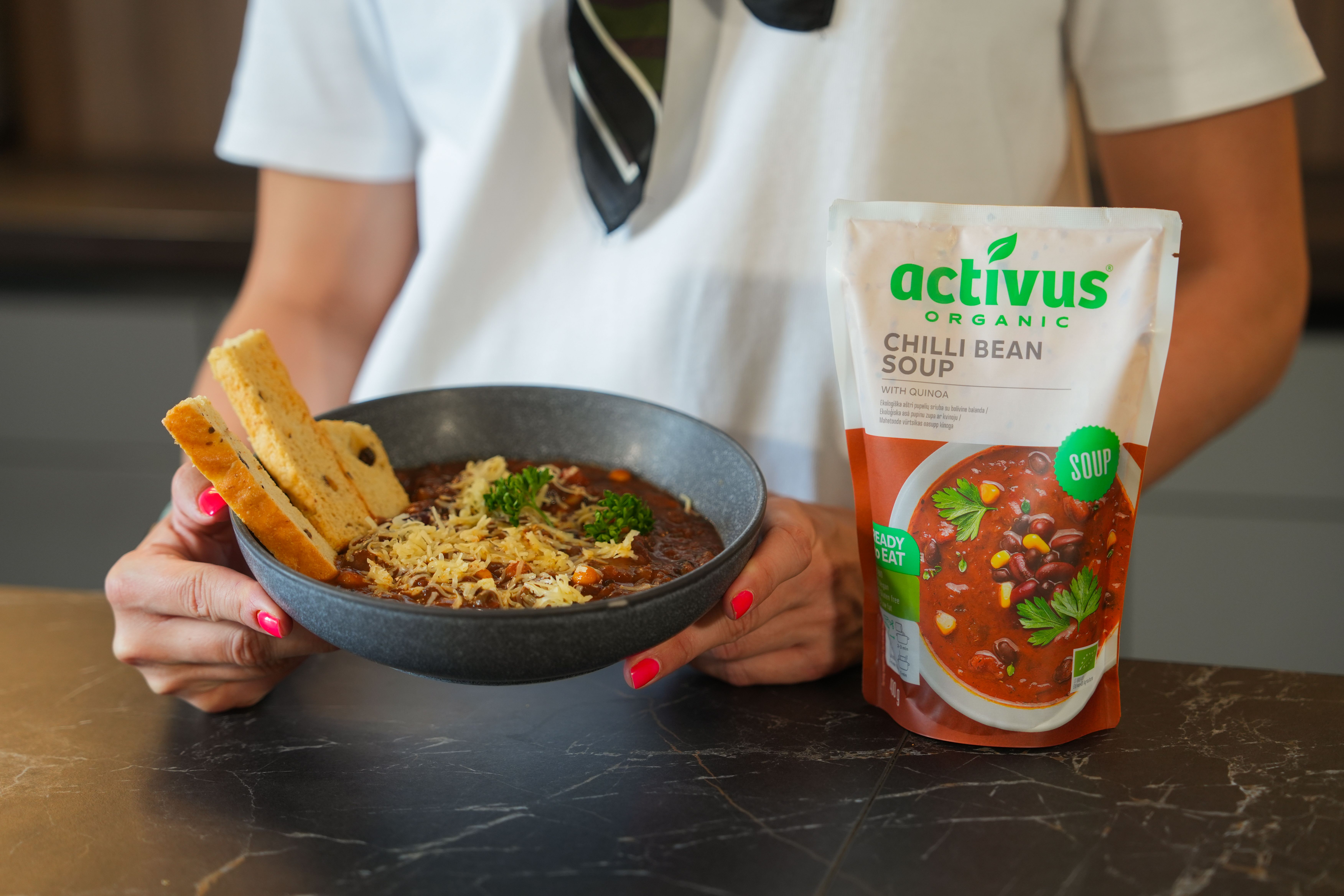
The meal is cooked inside its sealed packaging
One of the key features of this production method is that the meal is heat-treated in its sealed packaging. The product is prepared according to its recipe, packed and then transferred to the heat-treatment equipment.
“You could say that the product is cooked in its own packaging. The processing time and temperature are selected to suit the composition and quantity of each dish. The more food a pack contains, the longer it takes to reach and maintain the required temperature,” says Bakas.
Once the required treatment is complete, the product is cooled to stop the cooking process. This helps maintain both its safety and the qualities consumers value: flavour, colour and texture.
Why is refrigeration unnecessary?
We usually refrigerate soup or stew cooked at home, but the factory process is different. The meal is heat-treated in its sealed packaging, so it does not need to be repacked or otherwise prepared for storage afterwards.
“Heat treatment greatly reduces microbial contamination in the product. Because the entire process takes place in sealed packaging, the product is protected from recontamination from the surrounding environment. This is why it can be safely stored at room temperature while unopened,” explains Bakas.
An 18-month shelf life backed by testing
Activus ready-to-eat meals have a stated shelf life of 18 months. This is supported by more than a decade of manufacturing experience and product testing. To validate the stated shelf life, products are also tested beyond that period.
“If we declare an 18-month shelf life, we keep products for testing for 21 or even 24 months. We check their pH and microbiological parameters, and assess their flavour, colour and texture. This allows us to verify that the stated 18-month shelf life is appropriate,” says Bakas.
A 10-day hold before release
Product testing is just one part of ensuring food safety. The process begins much earlier, with the selection of raw material and spice suppliers. Incoming raw materials are tested in the company’s in-house laboratory, and their quality is also monitored during production. Finished products are not dispatched directly to customers: they first undergo a ten-day quarantine period.
“After production, we hold the products under specified conditions for ten days, then test their pH and microbiological parameters in the laboratory. Only products whose test results meet all the specified criteria are released to consumers,” Bakas notes.
He adds that testing is also carried out at external laboratories according to an established schedule. Attention is paid to the production environment as well as the product itself: after each production run, equipment is cleaned and disinfected, and samples are taken from its surfaces. This verifies that the equipment is ready for the next production run.
Packaging matters as much as the recipe
Because the meal is heat-treated in its packaging, the packaging itself plays an important role. It must meet food safety requirements, withstand the temperatures reached during production and remain sealed and flexible after heat treatment.
According to Bakas, these properties are important during production and throughout transport and storage. Packaging is therefore carefully selected and tested to verify its suitability for food contact.
“Not every type of packaging can withstand this kind of heat treatment. Packaging manufacturers carry out laboratory tests to ensure it meets food safety requirements, and we conduct additional checks for the migration of substances from the packaging into the food during heating. It is important to us that the packaging retains its properties and remains flexible and securely sealed throughout the entire production process,” says Bakas.